A baseline of one beats an average
Population norms describe a crowd. BAM learns the only physiology that matters to you — yours — and turns it into awareness you can act on, breath by breath.
Your normal isn't the average normal
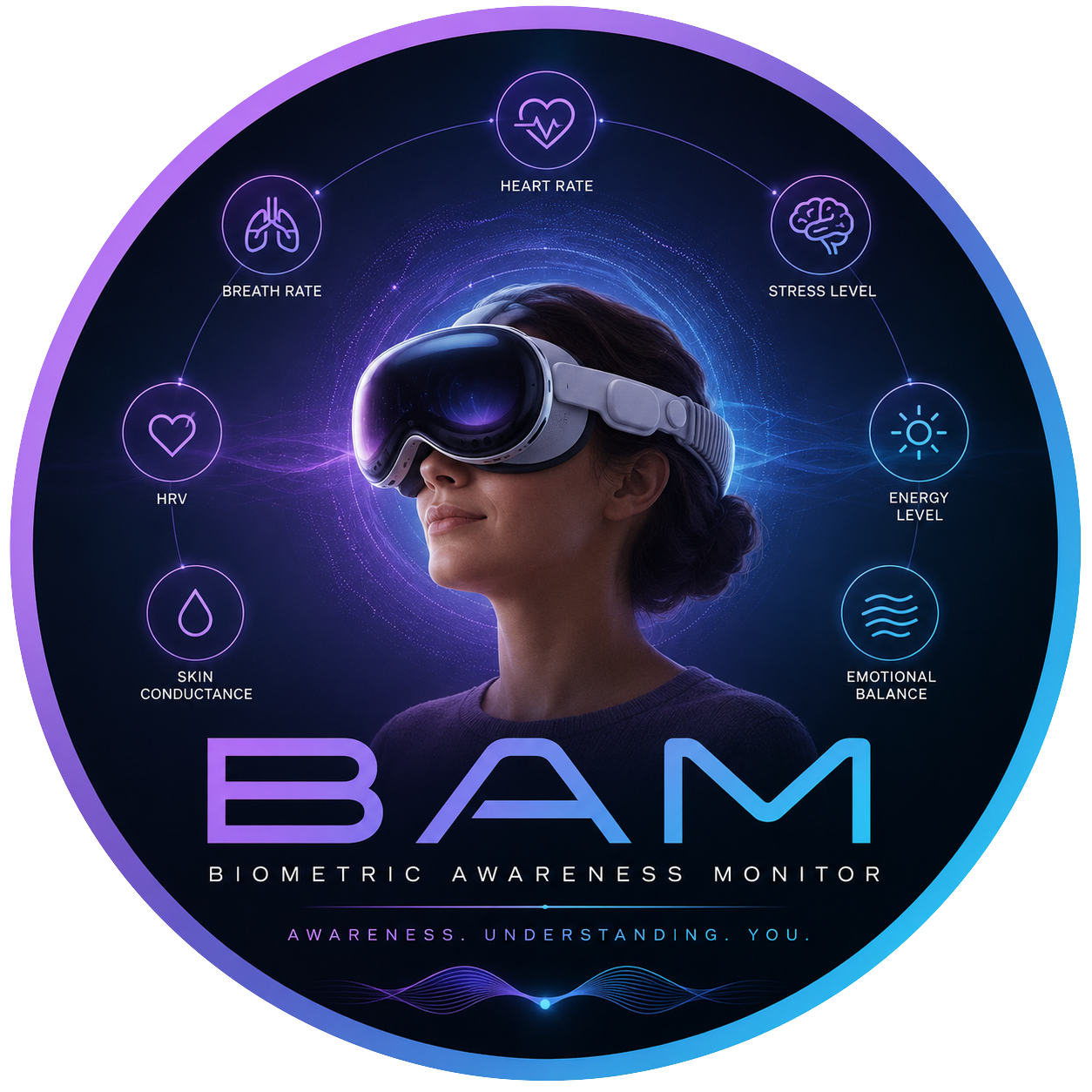
A resting heart rate, a breathing rate, a heart-rate-variability range — every textbook reports them as population averages. But you are not a population. The interesting signal lives in the gap between where you are right now and where your own body usually sits. BAM builds that personal baseline from your Apple Watch and HealthKit data, then reads every moment against it. The result is awareness tuned to one person, not a chart of everyone.
Your personalized HRV baseline feeds the patented four-step closed loop that tracks, evaluates, adapts, and re-measures in real time.
The science, in three moves
BAM rests on three well-studied ideas in human physiology — combined, on the Vision Pro, in a way nothing before could.
Your breath has a fingerprint
Breathing pace, depth, and rhythm shift with your state — and the pattern is distinctly yours. BAM learns the shape of your calm so it can notice when you drift from it.
Interoception is trainable
Interoception — sensing your own internal signals — is a skill that sharpens with feedback. Seeing your inside in your outside is the wedge that makes awareness practiceable.
A loop, not a library
Content libraries hand you the same session every time. A closed loop measures, adapts, and re-measures — so the next breath responds to the last one.
A coach, not a content shelf
TrackHeart rate, HRV, and breath stream in from Apple Watch and HealthKit — read continuously against your personal baseline, not a population chart.
EvaluateBAM places the live signal on a four-state scale, distinguishing your settled baseline from rising activation in real time.
Adaptive deliveryThe spatial experience responds to that reading — pacing breath, shifting the scene, guiding attention toward where your body actually is.
Re-measureThe effect is measured again and fed back in, so each cycle is informed by the last. This closed loop is the heart of US Patent 12,109,041 B2.
One scale, four states
Raw biometrics are noise until they mean something. BAM translates yours into a single patented four-state scale — from parasympathetic baseline through rising activation — so a glance tells you where your body is, and which way it's moving.
GreenParasympathetic · baseline · recovery · growth
YellowMild activation · worth noticing
OrangeSignificant arousal · caution
RedHigh activation · pause and recover